English
 Français
 Español
 Português
 中国人
中国人
Every woodworking shop reaches a point where the catalog just doesn’t cut it — literally. Maybe you’re trying to match a discontinued molding profile for a historic restoration. Maybe a client wants a one-of-a-kind detail that no standard knife in any catalog comes close to. Maybe you’ve got a legacy machine with unusual head specs, and finding tooling that fits feels like searching for a unicorn.
That’s where custom woodworking tooling comes in. And if the phrase “custom tooling” makes you picture a complicated, expensive, drawn-out ordeal — we’d like to change your mind. At CGG Schmidt, we’ve been making custom profile knives and cutting tools since 1926, and we’ve worked with shops of every size, from one-man operations to large production floors. The process is more straightforward than most people expect.
Signs It’s Time to Go Custom
Standard tooling is great — until it isn’t. Here are the situations where custom tooling makes the most sense:
- You’re reproducing a historical or discontinued profile. Restoration and millwork jobs often call for profiles that haven’t been in production for decades. A custom knife ground to match an existing sample or reference tracing is the only reliable way to get it right.
- Your design is proprietary or unique. If your shop produces signature furniture components, architectural elements, or cabinetry details that set you apart, custom tooling is what protects that look and keeps your runs consistent.
- Standard tooling keeps giving you tearout, chatter, or poor finish. Sometimes a custom geometry — adjusted hook angle, different relief, modified profile curve — solves a quality problem that off-the-shelf tools never quite fix.
- You’re running an unusual machine or head. Older shapers, molders, and tenoners often have non-standard head dimensions or corrugated back configurations that limit your tooling options. Custom tooling is often the only practical solution.
- You’re working difficult species or engineered materials. Some jobs call for specific carbide grades, S-Alloy steel, or geometry optimized for abrasive or hard materials. A knife ground for your exact application will outperform a general-purpose tool every time.
If any of those situations sound familiar, it’s worth a conversation. Custom tooling often costs less — and takes less time — than shops assume.
What You Need to Get Started
The barrier to ordering custom tooling is lower than most people realize. You don’t need engineering drawings or a formal specification package. What you actually need is one of the following:
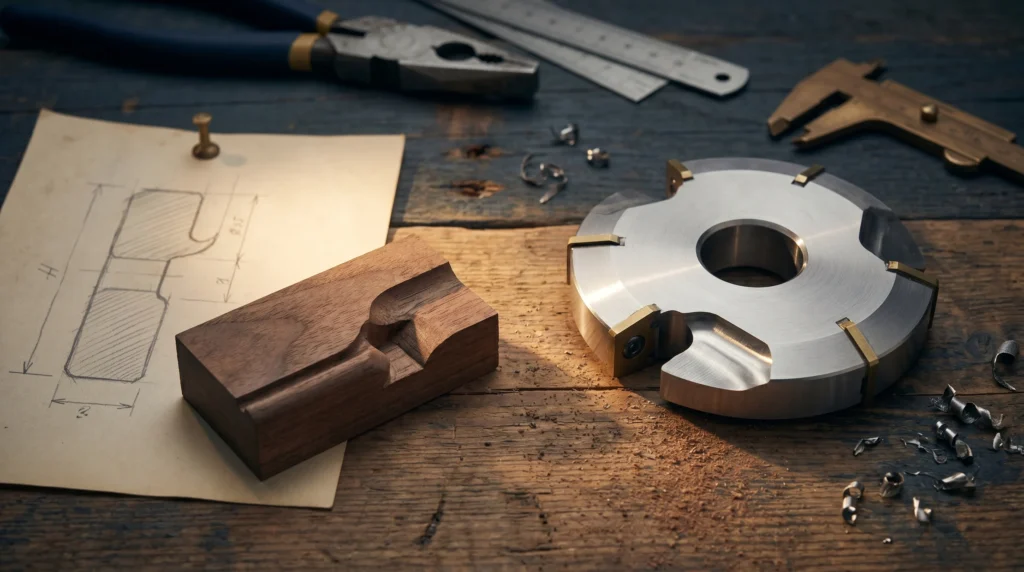
- A sketch — even a hand-drawn one with dimensions labeled. As long as we can read the profile and the critical measurements, we can work with it.
- A physical sample — a piece of actual molding, a sample block, or an existing worn knife. We can reverse-engineer the profile from a physical part.
- A DXF file — if you have CAD capability and can export a profile as a DXF, that’s the most precise starting point and streamlines the design step.
We’ll ask a few follow-up questions if we need them: What machine will this run on? What species or material? What head type? The more context you give us, the better — but don’t let uncertainty stop you from reaching out. We’ve sorted out the details on plenty of jobs that started with “here’s a photo and a rough sketch.”
How the Custom Tooling Process Works
Here’s what happens from the moment you contact us to the day your tools ship.
1. Intake and consultation. You send us your sketch, sample, or DXF along with your machine and material details. We review it and confirm we understand the spec. If something’s unclear, we’ll reach out — usually quickly, because the sooner we clarify, the sooner we can start.
2. Design and verification. Our team translates your input into a precise tool design. For complex profiles, we’ll confirm the geometry against your reference before cutting steel, so there are no surprises downstream.
3. CNC grinding. We grind the knife to spec on our CNC grinding equipment. CNC gives us tight, repeatable tolerances — the kind of accuracy that matters when you’re trying to match a profile within a few thousandths of an inch, or when a tool needs to run precisely in a gang setup.
4. Optical comparator inspection. Every custom knife goes to our high-powered optical comparator before it ships. The comparator projects a magnified image of the tool’s profile, letting us verify the geometry against the intended spec in fine detail. It’s one of the most reliable ways to catch any deviation before it becomes your problem.
5. Packaging and shipment. Tools are carefully packaged and shipped to you. Turnaround varies with complexity and current shop volume — we’ll give you a realistic timeline when you place your order.
Custom Tooling for Any Size Shop
One of the things we hear most often from first-time customers is surprise at how accessible custom tooling is. You don’t need to be a high-volume production operation to make custom tooling pencil out. A single specialty knife that lets you take on a job you’d otherwise have to turn down can pay for itself immediately.
We’ve been solving tooling problems for woodworkers since 1926 — small shops, large shops, millwork houses, furniture makers, restoration specialists, and everyone in between. Whatever you’re building, if standard tooling isn’t working, bring us your toughest job.
Ready to explore custom woodworking tooling for your shop? Call us at 1-800-SCHMIDT, email sales@cggschmidt.com, or send us your sketch, sample, or DXF file and let’s get started. We’re glad to talk through the options before you commit to anything.