English
 Français
 Español
 Português
 中国人
中国人
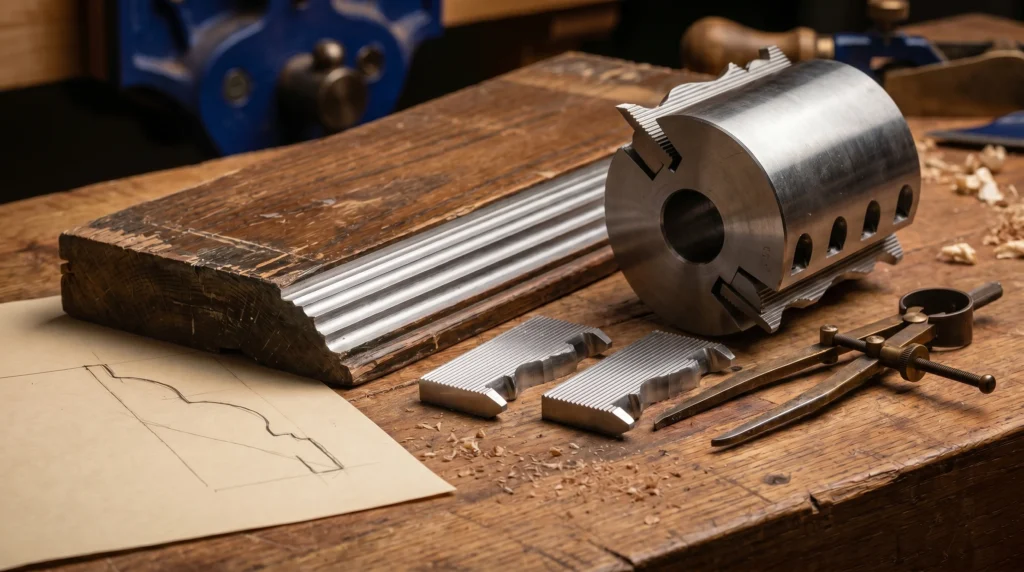
It’s one of the most common calls we get: a contractor is mid-renovation and discovers that a stretch of original molding needs to be replaced or extended — but the profile hasn’t been in a catalog for thirty years. Or a furniture restorer needs to reproduce a carved edge that exists on exactly one piece, nowhere else. Or a millwork shop is doing a run of custom cabinetry that has to match the client’s existing doors exactly.
In all of these situations, the answer is a match molding profile knife — a custom-ground knife that reproduces the specific profile you need. At CGG Schmidt, profile grinding has been our business since 1926, and matching existing profiles is one of the things we do most often. Here’s what you need to know to get started.
Why Matching Is Trickier Than It Looks
At first glance, matching a molding sounds simple: find the profile, grind the knife. But matching has a few specific challenges that make it different from ordering a knife to a new spec.
Your reference might not be perfect. An existing molding sample can be worn, painted, chipped, or slightly distorted from years of expansion and contraction. A tracing might have small measurement errors. Even a good-quality photo can distort curved surfaces in ways that aren’t obvious until you try to grind from it.
That’s why the quality and completeness of what you send us matters. The more accurately we can understand the profile you need, the more precisely we can grind the knife — and the more confidently you can run it knowing it’ll match.
What to Send Us
You have several good options for getting us the profile information. Use whichever fits what you have available.
A physical molding sample is often the best reference. Send us an actual piece of the molding — ideally a clean, undamaged section. We can take direct measurements from the sample, cross-check radii and transitions, and develop the knife geometry from a real-world reference rather than an abstraction of one. If the sample has some wear or paint, let us know — we’ll account for it.
A profile tracing or template is a good alternative when sending the physical piece isn’t practical. Press the molding against a piece of paper and trace the profile, or use a profile gauge to capture the shape and then trace that onto paper. Include your best measurements of critical dimensions — overall height, width, depth of any coves or beads, and any transition radii you can measure. The more dimensions you include, the more confidence we have in the result.
A dimensioned sketch — hand-drawn is fine — works well for simpler profiles or when you’ve already measured the profile carefully and can describe it in numbers. Include the full profile shape and label all the dimensions. A sketch with solid measurements is often cleaner to work from than a tracing with no dimensions.
A DXF file is the most precise option if you have CAD access. Export the profile as a DXF, and we can work directly from that geometry. This is especially useful for profiles with complex curves or multiple elements where small errors in a hand tracing could compound.
What Else We’ll Need to Know
Beyond the profile itself, a few additional details help us grind the right knife:
- Machine and head type. What machine will you run this knife on? Shaper, moulder, Williams & Hussey, corrugated head? The head configuration determines the knife blank we start with and affects some geometry details.
- Material. What species or material will you be cutting? Some materials call for different steel grades or geometry choices that affect tool life and finish quality.
- Scale and orientation. When you send a tracing or sketch, tell us which side is the face of the molding and include a reference measurement so we know the absolute size of the profile.
If you’re unsure about any of this, don’t let it stop you from reaching out. We can often work through the details together once we see what you’ve got.
How the Matching Process Works
Once we have your reference, we develop the knife geometry — translating your sample, tracing, or DXF into a precise grinding spec. We use high-powered optical comparators to verify the profile at each stage, comparing the knife geometry against your reference with fine detail. This is how we catch deviations before they become problems.
For jobs where the match is especially critical — say, a high-visibility restoration where the new section has to be indistinguishable from the original — let us know upfront. We’ll pay particular attention to any complex or subtle transitions in the profile.
Turnaround varies with complexity, steel selection, and current shop volume; we’ll confirm a realistic timeframe when you place your order. If your job has a deadline, tell us — we’ll do our best to work with you.
Don’t Let a Discontinued Profile Stop Your Job
A matching job shouldn’t mean turning down work or leaving a renovation incomplete. Whether the profile you need is a hundred years old or just out of production, if you can give us a reference to work from, we can very likely grind a knife that matches it.
We maintain over 170 standard profiles in stock for corrugated heads and the Williams & Hussey molder, so it’s always worth asking whether a standard profile comes close before going fully custom. But when it needs to be exact, custom grinding is the answer.
Call us at 1-800-SCHMIDT, email sales@cggschmidt.com, or send us your sample, tracing, sketch, or DXF and let’s talk through the match. We’ve been reproducing profiles precisely since 1926 — bring us yours.