English
 Français
 Español
 Português
 中国人
中国人
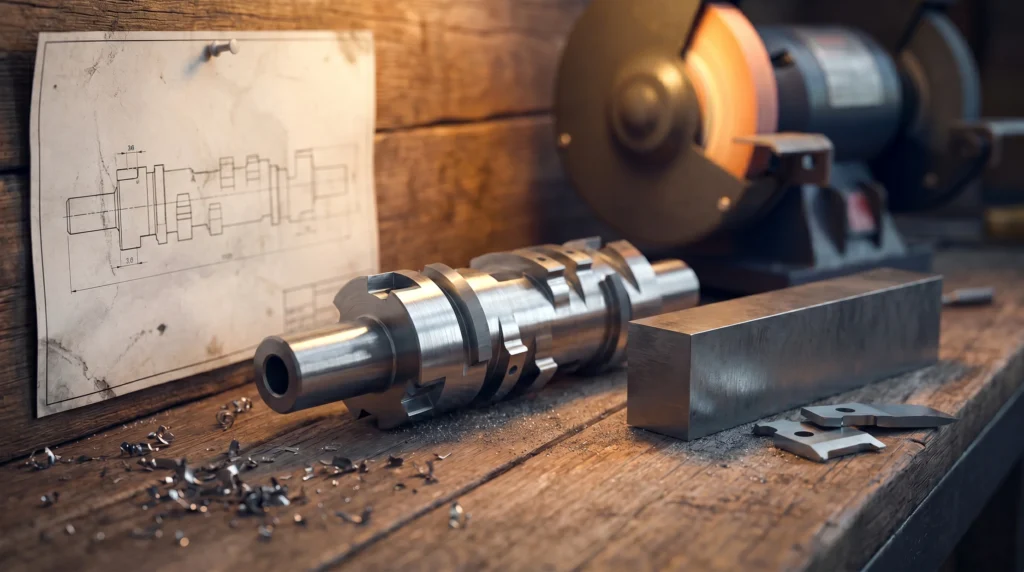
There’s something satisfying about holding a finished knife and knowing it exists because someone brought us a sketch on a piece of paper. That’s not a figure of speech — it really does start that way sometimes. A shop owner sends a hand-drawn profile on a napkin, or a millwork contractor drops off a worn sample with a few dimensions scrawled in marker, and a few steps later there’s a precision-ground custom profile knife ready to run.
We’ve been doing this since 1926 at CGG Schmidt. The equipment has evolved, but the core commitment hasn’t: take what the customer needs and translate it into a tool ground to precise tolerance. Here’s how we do it, step by step.
Step One: Receiving Your Spec
Every custom knife job starts with information from you. That information can take several forms, and we’ve successfully worked from all of them:
- A dimensioned sketch — hand-drawn or CAD-printed, as long as the profile shape and key measurements are legible. We’ll ask for clarification if anything is ambiguous.
- A physical molding sample — an actual piece of wood with the profile you want to reproduce. We can take measurements directly from the sample and reverse-engineer the knife geometry.
- A DXF file — a CAD export of the profile, which gives us the cleanest, most precise starting point and can speed up the design step.
Along with the profile spec, it helps to know what machine the knife will run on, what material you’ll be cutting, and what head type (corrugated back, shaper, moulder, wing cutter, etc.) you’re working with. If you’re not sure about some of those details, that’s fine — we can often sort that out together. The goal at this stage is simply to make sure we understand exactly what you need before we cut any steel.
Step Two: Design and Confirmation
Once we have your spec, we develop the precise tool geometry. This means translating your sketch or sample into the exact angles, curves, and dimensions that will produce the profile you want — accounting for the machine it runs on, the material it cuts, and any geometry factors that affect finish quality and tool life.
For profiles with critical details — tight radii, complex ogee curves, multiple beads, or unusual transitions — we may verify the design with you before proceeding. A quick confirmation at this stage costs almost nothing. A correction after grinding costs more. We’d rather take the extra minute.
This step is where decades of experience matter. Knowing how a slight change in hook angle affects tearout on a hard maple run, or how to grind a profile so it tracks cleanly in a corrugated head, is the kind of thing you accumulate over time. Profile knife grinding has been our specialty since 1926, and that depth shows in the design work.
Step Three: CNC Grinding
With the design confirmed, the knife goes to our CNC grinding equipment. CNC grinding is what gives modern custom tooling its precision and repeatability. The machine follows the programmed profile path with tight tolerances, removing material in controlled passes to bring the knife to final geometry.
This precision matters for several reasons. A profile knife that’s off by even a few thousandths of an inch in a critical radius will produce a molding that doesn’t match your reference — and on a restoration or matching job, that’s not acceptable. On a production run, a knife that’s not ground consistently will produce inconsistent parts. CNC grinding minimizes both problems.
It also means that if you need a second knife ground to the same spec — whether next month or years from now — we can hold that profile accurately, run after run.
Step Four: Optical Comparator Inspection
After grinding, every custom knife goes to our high-powered optical comparator for inspection. This is one of the most valuable steps in the process, and it’s one of the things that separates serious custom knife grinding from cutting corners.
An optical comparator projects a magnified silhouette of the tool’s profile onto a screen, where it can be measured and compared against the intended geometry with high precision. We’re checking that every radius, angle, flat, and transition matches the spec. Any deviation shows up clearly at this magnification.
If something needs a correction, it happens here — before the knife ships, not after it causes a problem on your machine or in your product. This inspection step is part of why shops trust us to hold tight tolerances on critical work.
Step Five: Packaging and Shipment
A finished, inspected knife gets carefully packaged to protect the edge and the profile through transit. We’re shipping something precision-ground; the packaging reflects that.
Turnaround time varies depending on profile complexity, steel selection, and current shop volume. Simple profiles on standard material move faster; complex multi-step profiles or special steel specifications take longer. When you place your order, we’ll give you a realistic timeframe — we’d rather set an honest expectation than overpromise.
The Craft Behind the Custom Profile Knife
What we’ve described above is a process — but behind the process is a craft. Reading a sketch and understanding the intent. Knowing when a spec needs a clarifying question versus when it’s clear enough to run with. Recognizing how a profile will behave in the cut before the knife ever touches wood. That’s not something a piece of equipment does on its own.
CGG Schmidt has been doing this work for nearly a century. The result of that experience is a shop that can handle the ordinary custom job and the genuinely unusual one — the profile that reproduces a 19th-century architectural detail, the knife geometry nobody else wants to attempt, the matching job where the reference is a worn, chipped sample and the customer needs it to come out exactly right.
Ready to put that experience to work? Send us your sketch, sample, or DXF file, call 1-800-SCHMIDT, or reach out at sales@cggschmidt.com. Let’s make your custom profile knife together.