English
 Français
 Español
 Português
 中国人
中国人
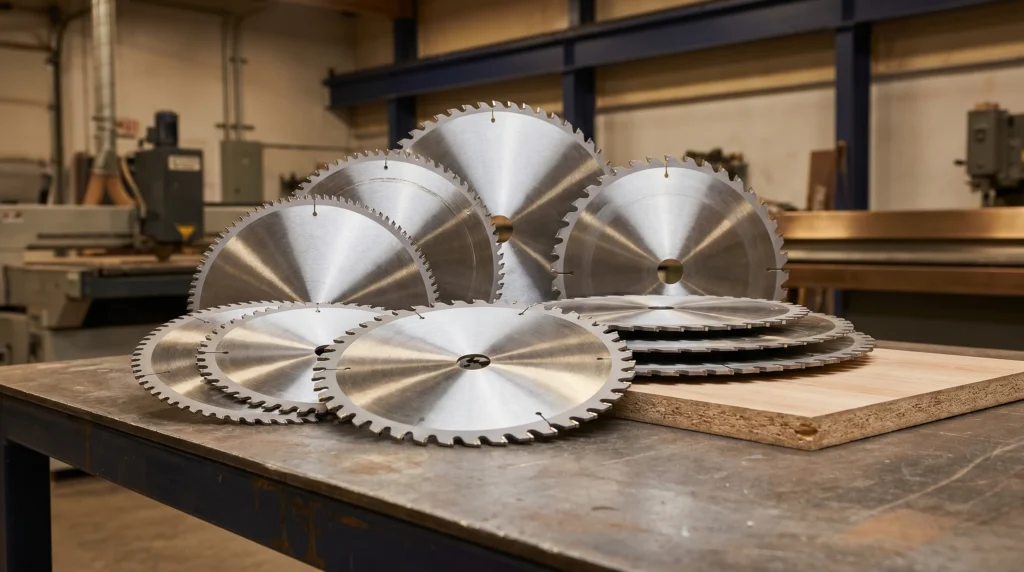
Sawing is the first operation in most production woodworking workflows, and the quality of that first cut ripples through everything that follows. The right industrial saw blade for woodworking produces clean, consistent cuts that minimize secondary processing — and the wrong one leaves you dealing with tearout, chip-out, rough edges, and wasted material. This overview matches the main blade and head types to the applications where they perform best.
Why Blade Selection Matters in Production
In a production environment, saw blades aren’t just cutting tools — they’re part of your quality control system. A blade that matches your material and application reduces edge prep time, lowers defect rates, and extends the intervals between blade changes. Over the course of a shift, the difference between an appropriate blade and an approximate one shows up clearly in yield and throughput.
CGG Schmidt produces a full range of saw blades for panel saws, table saws, beam saws, and sliding table saws — both standard designs and custom configurations for specific materials or machine setups.
Panel Saw Blades: Clean Cuts Through Sheet Goods
Panel blades are designed for cutting sheet materials — plywood, MDF, particleboard, melamine, and veneered panels. They typically feature a high tooth count with ATB (alternate top bevel) or combination grind geometry, producing smooth edges with minimal chip-out on face veneers.
In a production cabinet or furniture shop, the panel blade is the most frequently used blade in the building, and it earns its keep every day. Key considerations when selecting a panel blade:
- Tooth count: Higher tooth count = smoother edge; lower = faster cut with more edge roughness
- Carbide grade: Harder, more wear-resistant carbide extends life on abrasive materials like MDF
- Plate tension: A properly tensioned plate runs flat and true; cheap blades often fail here first
Scoring Blades: The Solution to Chip-Out on Veneered Panels
When cutting veneered panels or melamine on a panel saw or beam saw, the bottom face of the panel — the side the blade first contacts — is prone to chip-out. A scoring blade is a small-diameter blade that runs ahead of the main blade, cutting a shallow groove in the bottom face before the main blade passes through. The result is a clean, chip-free bottom edge.
Scoring blades run in counter-rotation to the main blade and must be precisely aligned and set to the correct depth — typically just deep enough to sever the veneer or coating without cutting through the substrate. Correct setup makes a significant difference in the quality of the scored edge.
CGG Schmidt produces scoring blades in standard configurations for common European-style panel saws and sliding table saws, as well as custom sizes for older or specialty equipment.
Rip Blades: Efficient Breakdown of Solid Lumber
Rip blades are optimized for cutting solid wood parallel to the grain — breaking down lumber to width or producing blanks for further processing. Compared to crosscut and panel blades, rip blades typically have:
- Fewer teeth — typically 24–40 on a 10″ blade — for aggressive chip clearance
- Flat-top grind (FTG) geometry, which is efficient at shearing wood fibers along the grain
- Larger gullets to clear the heavier chips produced in ripping
A good rip blade moves lumber through the saw efficiently and produces a cut surface smooth enough to go directly to a jointer or planer without excessive cleanup.
Glue-Line Rip Blades: When the Cut Has to Be the Joint
Glue-line rip blades take the ripping concept further — they’re designed to produce a cut surface smooth and flat enough to glue directly, without jointing. This is a significant time-saver in edge-gluing operations for panels, tabletops, and similar work.
Glue-line blades use an alternating top bevel or hi-ATB grind and require more teeth than a standard rip blade. The tradeoff is slightly reduced feed rate compared to an aggressive rip blade, but the elimination of a jointing step more than compensates in many workflows.
For shops that edge-glue significant volumes of solid lumber, a quality glue-line blade pays for itself quickly.
Laminate and Solid-Surface Blades: Specialized Cutting for Challenging Materials
Laminate Blades
High-pressure laminate (HPL) and plastic laminate are abrasive and brittle — they chip easily and dull standard carbide quickly. Laminate-specific blades use a very fine ATB grind with a high tooth count and high-density carbide grades that resist the abrasion of laminate without chipping.
Running the wrong blade on laminate produces ragged, chipped edges that require extensive edge-banding or trim work. The right blade produces a clean, ready-to-use edge.
Solid-Surface Blades
Solid surface materials — the acrylic and polyester composite countertop materials — present their own cutting challenges. They’re dense, abrasive, and prone to stress cracking if the blade isn’t right. Solid-surface blades are designed to cut cleanly without generating the heat and cutting forces that cause micro-cracking in the material.
These are specialty blades that most shops don’t need in large numbers, but for fabricators who work with solid-surface countertops, having the right blade is essential to quality work.
Miter and Chop Saw Blades
Miter saws — whether sliding compound miters or radial arm saws — are the primary crosscutting tools in many shops. The right miter/chop blade balances clean finish quality with reasonable cut speed. For fine finish crosscutting of solid wood and mouldings, high tooth count ATB blades produce the smoothest results. For structural framing and rough dimensioning, a lower tooth count with more aggressive geometry speeds the work.
CGG Schmidt produces miter and chop saw blades in the diameters common to production shop equipment.
A Simple Application Guide
| Blade Type | Primary Application | Key Feature |
|---|---|---|
| Panel blade | Sheet goods, plywood, MDF | High tooth count, clean face |
| Scoring blade | Veneered/melamine panels | Eliminates bottom chip-out |
| Rip blade | Solid lumber breakdown | Low tooth count, fast chip clearance |
| Glue-line rip | Edge-gluing production | Glue-ready cut surface |
| Laminate blade | HPL and plastic laminates | Fine grind, abrasion-resistant carbide |
| Solid-surface blade | Countertop fabrication | Clean cut, no micro-cracking |
| Miter/chop blade | Crosscutting, finish cuts | Smooth finish, splinter-free |
The Right Blade Is a Production Decision
In a busy shop, it’s tempting to run one blade for everything. But mismatched blades cost more in the long run — in edge prep time, wasted material, and shortened blade life. Keeping the right blade on the right saw is one of the simplest things you can do to improve cut quality and reduce rework.
CGG Schmidt produces saw blades to production standards, in both standard configurations and custom sizes for specific machine and material requirements. If you’re not sure which blade fits your application, or you need a non-standard diameter or bore, give us a call.
Reach us at 1-800-SCHMIDT or sales@cggschmidt.com — we’re glad to help you find the right industrial saw blade for your woodworking operation.