English
 Français
 Español
 Português
 中国人
中国人
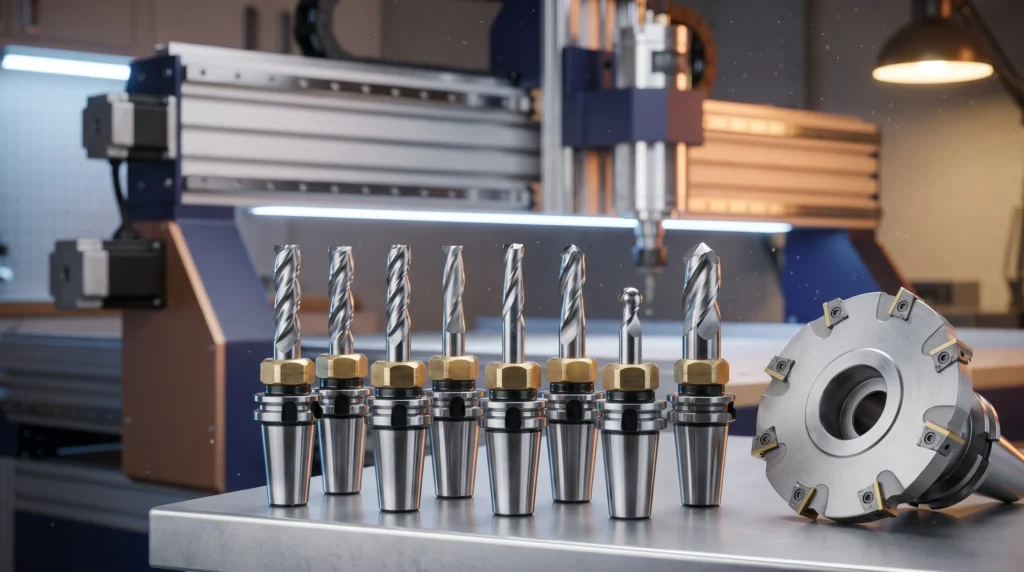
CNC routers have become central to production in cabinet shops, furniture manufacturers, sign makers, and millwork operations of every size. The machine is only as good as the tooling in it, and good CNC router tooling decisions touch everything from edge quality and sheet yield to cycle times and bit life. This guide covers the main categories of CNC tooling, how holders and collets affect performance, and practical strategies for getting clean results while keeping costs in check.
The Foundation: Solid Carbide Router Bits
Most CNC router tooling for woodworking is solid carbide — and for good reason. Solid carbide bits are stiffer than steel, which reduces deflection under cutting load. They hold a sharp edge longer, especially in abrasive materials like MDF, melamine, and plywood with glue-line veneers. And they can run at higher speeds without the heat buildup that shortens tool life.
CGG Schmidt produces solid carbide CNC router bits for a wide range of applications. The main categories include:
- Straight bits — general-purpose cutting, dadoes, rabbets, and pocketing
- Compression bits — upcut geometry on the lower portion, downcut on the upper, for clean top and bottom edges on veneered panels in a single pass
- Upcut spirals — efficient chip evacuation, aggressive material removal; good for pocketing and through-cuts in solid material
- Downcut spirals — press chips downward for a clean top surface; useful for finish-quality cuts on show faces
- V-groove and engraving bits — lettering, decorative V-cuts, and chamfers
- Surfacing and spoil-board bits — large-diameter tools designed to skim flat surfaces (more on these below)
Choosing the right geometry is the first step toward clean cuts. A compression bit running on a veneered panel will give you a cleaner edge than an upcut spiral, but the upcut will remove material faster in a solid-wood pocket. Matching the bit to the operation is the most important CNC tooling decision you’ll make.
Tool Holders and Collets: The Often-Overlooked Variables
A solid carbide bit is only as precise as the holder it sits in. Tool holders and collets affect runout — the tiny wobble of the bit tip as it spins. Excessive runout causes uneven chip loads, rough finishes, accelerated flute wear, and in extreme cases, tool breakage.
Collets
The collet is the clamping mechanism that grips the shank of your router bit inside the spindle. Collets come in standard shank sizes — typically 1/4″, 1/2″, and metric equivalents for European machines. A worn or damaged collet won’t hold the bit concentrically, and the results show up immediately in cut quality.
Replace collets on a regular schedule — they’re a relatively low-cost consumable that has a disproportionate effect on tool performance. Never run a collet that shows visible wear, corrosion, or doesn’t grip cleanly.
Tool Holders
In higher-end CNC setups, tool holders (also called chuck systems or arbors, depending on configuration) hold the collet assembly and mount to the spindle. Quality holders maintain tight tolerances and contribute to low runout across the full assembly. CGG Schmidt supplies collets and tool holders matched to common CNC router spindle configurations.
A few practical points on holders and collets:
- Keep them clean. Chips and dust in the collet bore cause inconsistent clamping and runout.
- Use the right shank size. Never use a reducer sleeve if you can avoid it — a direct-fit collet is always more accurate.
- Torque to spec. Overtightening collets can damage both the collet and the bit shank.
Spoil-Board Cutters: Keeping Your Table Flat
A CNC router’s spoil board — the sacrificial surface the workpiece sits on — takes a beating over time. As it gets damaged and resurfaced, it loses flatness, and an uneven spoil board means uneven cut depths across the sheet.
Spoil-board cutters (also called surfacing cutters or fly cutters) are large-diameter tools — typically with multiple carbide inserts — designed to skim the spoil-board surface flat and true. Regular spoil-board maintenance with a quality cutter keeps your reference surface accurate and extends the useful life of your spoil board before it needs replacement.
When selecting a spoil-board cutter:
- Choose a diameter that balances coverage width with your machine’s spindle power
- Carbide insert designs allow easy replacement of worn cutting edges
- Run at conservative feed rates for a smooth, flat finish rather than maximum material removal
Cutting Strategies for Clean Edges and Long Tool Life
The best tooling in the world won’t perform well if the cutting parameters aren’t dialed in. A few principles apply across most CNC woodworking operations:
Match chip load to material. Chip load — the thickness of material each flute removes per revolution — should be appropriate for the material. Too little chip load (slow feed, high RPM) generates heat and dulls tools fast. Too much (high feed, low RPM) causes deflection and rough cuts. Most bit manufacturers publish recommended starting parameters; use them as a starting point and adjust from there.
Climb cutting vs. conventional cutting. For finish passes, climb cutting (where the bit rotation and feed direction work together) often produces a cleaner edge. For roughing passes, conventional cutting is typically more stable. Many CNC operators run a conventional roughing pass followed by a climb-cut finish pass for the best combination of speed and quality.
Ramping into cuts. Rather than plunging straight down at full depth, a ramped entry reduces the load on the tip of the bit and extends tool life, especially in pocketing operations.
Depth of cut. Multiple shallow passes are gentler on tooling than one aggressive full-depth pass, especially in dense hardwood or thick panels. Longer tool life and better surface quality typically result.
Keep tools sharp. Dull bits don’t just produce poor finishes — they generate more heat, increase cutting forces, and can cause the machine to work harder than it should. Track your footage and replace or recondition bits on a consistent schedule.
Sourcing CNC Tooling That Holds Up in Production
CNC router bits are consumables, but they’re not all the same. The quality of the carbide substrate, the precision of the grind, and the consistency of the geometry from bit to bit all affect your results. CGG Schmidt produces solid carbide CNC tooling built for production use — not the bargain-bin bits that look right in the box but wear out before the shift is done.
If you’re setting up a new CNC program, adding a material to your production line, or trying to track down why your edge quality has dropped, we’re happy to talk through your application and recommend the right tooling.
Call 1-800-SCHMIDT or email sales@cggschmidt.com — let’s find the CNC router tooling that keeps your machine running at its best.