English
 Français
 Español
 Português
 中国人
中国人
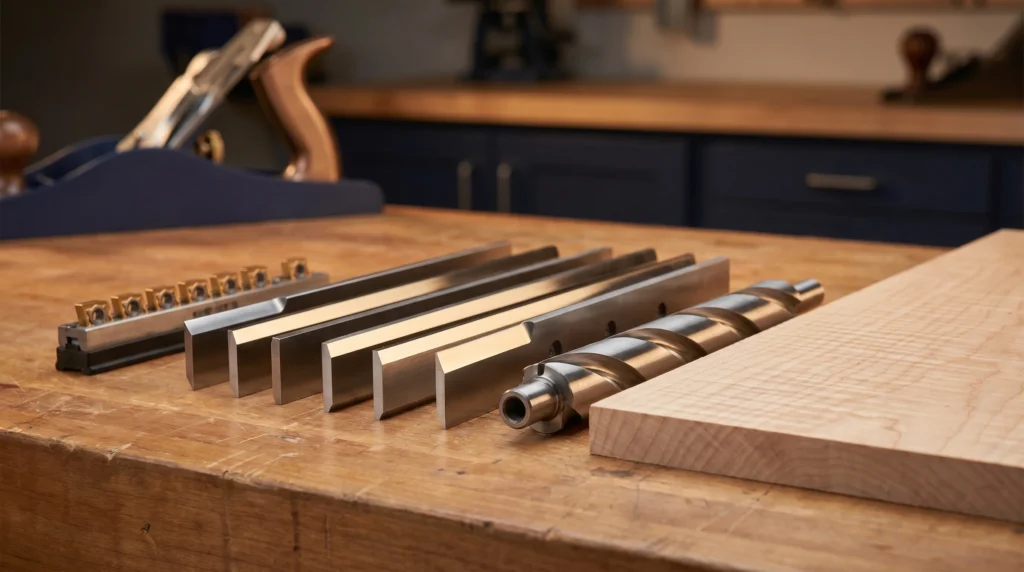
Planer and jointer knives are among the most frequently replaced consumables in a woodworking shop, and they have a direct impact on surface quality, machine performance, and throughput. Choosing the right planer and jointer knives — and understanding the systems they fit — helps you get better results from your machines while managing tooling costs intelligently. This guide walks through the main knife types, the quick-change systems on the market, and the material choices available.
Why Knife Selection Matters
A planer or jointer removes material with rotating knives mounted in a cutterhead. The condition and geometry of those knives determine whether you get a smooth, flat surface or a rough one that requires sanding to clean up. Dull knives also increase feed resistance, putting more load on your machine and its feed system. Fresh, sharp, properly set knives let the machine do its job the way it was designed to.
Thin Knives vs. Standard Knives
The most fundamental distinction in planer and jointer knives is thickness.
Standard (thick) knives are the traditional type — typically 1/8″ thick or more. They’re used in older and many current production machines. Standard knives can be resharpened multiple times before they’re retired, making them a cost-effective long-term choice for shops that have the grinding capability in-house or a reliable sharpening service nearby.
Thin knives — sometimes called “throwaway” or “disposable” knives — are thinner, typically double-edged, and designed to be flipped or discarded rather than reground. They’re common in benchtop and mid-range machines and in quick-change systems (more on those below). The appeal is simplicity: no grinding, no setting, just a fast knife change and you’re back in production.
For many production shops, a mix of both makes sense: standard knives on machines where grinding economics work out, thin knives on machines where changeover speed and simplicity matter more.
Quick-Change Knife Systems
Several engineered quick-change systems have become widely adopted for planers and jointers. Each uses a proprietary knife geometry that locks into a matched cutterhead, allowing fast, repeatable knife changes without a dial indicator or setting gauge.
Tersa System
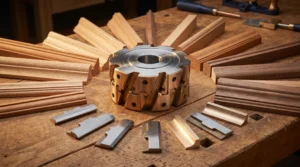
The Tersa system uses a trapezoidal-cross-section knife that drops into matching slots in the Tersa cutterhead. Centrifugal force locks the knife in place as the head spins — no wedges, no bolts, no setting. Knife changes take minutes. Tersa knives are available in HSS (high-speed steel) and carbide, and in custom lengths to fit virtually any machine equipped with a Tersa head.
Terminus System
The Terminus system uses a similar quick-change concept with its own knife geometry. Like Tersa, it’s designed for fast, accurate knife installation. Terminus knives are available from CGG Schmidt in the sizes that fit machines equipped with Terminus heads.
Centrolock System
The Centrolock system takes the quick-change idea further — knives index positively in the head, ensuring consistent height setting every time. This is particularly valuable in production environments where knife-change frequency is high and any variance in knife height affects finished-surface consistency. Centrolock heads and knives are a popular upgrade in shops that want production-level reliability without a dedicated setup technician at every knife change.
Knife Materials: HSS, Carbide-Tipped, and Solid Carbide
Knife material choice has a significant effect on edge life, surface quality, and cost per linear foot.
High-Speed Steel (HSS) is the standard material for most planer and jointer work on solid wood. It sharpens well, produces excellent surface quality, and is tough enough to handle the occasional minor inclusion. Most resharpened knives are HSS.
Carbide-Tipped knives carry a carbide edge on an HSS or alloy steel body. They hold an edge dramatically longer than straight HSS — especially in abrasive materials like MDF, particleboard, and glued panels. The tradeoff is that carbide is harder to regrind and more sensitive to impact from inclusions. For shops running a lot of engineered sheet goods or composite materials through their planer, carbide-tipped knives often reduce overall tooling costs despite the higher per-knife price.
Solid Carbide knives are used in specific applications where maximum edge life is the priority and the material being processed is consistently abrasive. Less common in standard planer/jointer applications, but available for demanding production situations.
CGG Schmidt produces planer and jointer knives in S-Alloy steel — a premium tool steel that provides excellent edge retention and surface finish on solid lumber.
Selecting Knives for Your Application
A few questions guide the selection process:
- What machine do you have? The cutterhead design determines whether you need standard knives, thin knives, or a specific quick-change format (Tersa, Terminus, Centrolock).
- What material are you processing? Solid hardwood and softwood favor HSS; abrasive materials favor carbide.
- What’s your volume? High-volume production shops benefit from quick-change systems and carbide’s longer run time between changes. Lower-volume custom shops may find HSS and traditional knives more economical.
- Do you have in-house grinding? If yes, standard resharpening makes economic sense. If not, disposable or quick-change thin knives reduce dependency on outside services.
Working With a Custom Knife Supplier
Not every planer or jointer takes a standard off-the-shelf knife. Older machines, imported equipment, and specialty heads sometimes require knives ground to non-standard lengths, widths, or profiles. CGG Schmidt can produce custom planer and jointer knives to any specification — send the dimensions, or pull an old knife and send it as a sample, and we’ll match it.
If you’re not sure what system your machine uses or what knife spec it takes, a quick call usually sorts it out. The team at CGG Schmidt has seen a wide range of machines and can help you identify what you need.
Contact us at 1-800-SCHMIDT or sales@cggschmidt.com — we’re glad to help you find the right knives for your planer or jointer and keep your machines running at their best.