English
 Français
 Español
 Português
 中国人
中国人
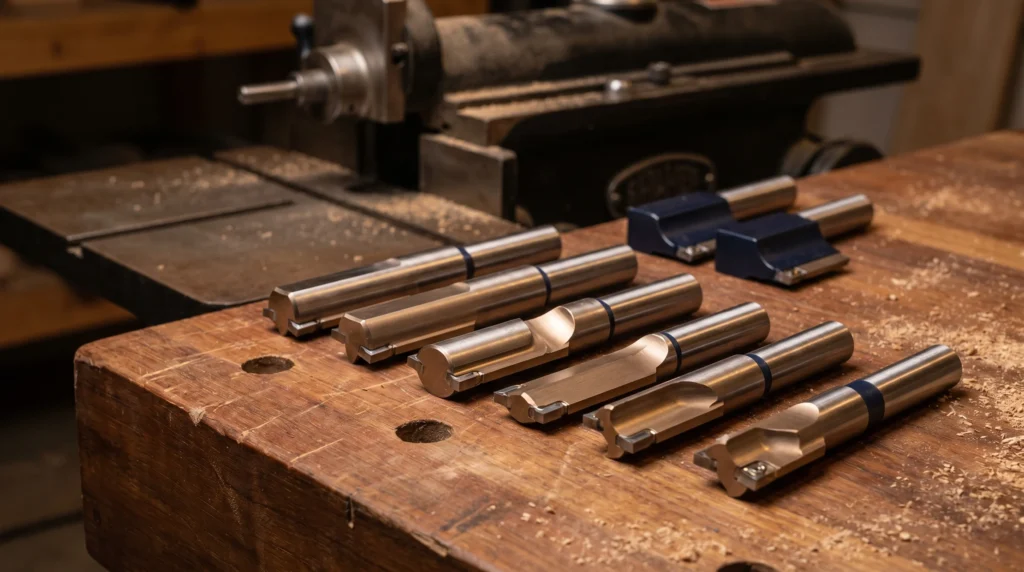
If you’ve ever stood in front of a wall of shaper cutters wondering which one will actually do the job, you’re not alone. Knowing how to choose shaper cutters that match your machine, your material, and your desired profile can mean the difference between crisp, repeatable results and a frustrating afternoon of trial and error. This guide walks you through every factor worth considering before you place an order.
Start With the Profile You Need
The profile is the shape the cutter will leave on the wood — an ogee, a cove, a bead, a raised panel, or any one of hundreds of other contours used in millwork, cabinetry, furniture, and architectural trim. Before you look at anything else, get your profile sorted out.
If you’re working from a set of shop drawings or an existing sample piece, you have a head start. For standard profiles, CGG Schmidt stocks more than 170 patterns that can ship without lead time. If your profile is unusual, custom, or matched to an existing architectural feature, the team can grind to a sketch, a wood sample, or a DXF file — so don’t assume a custom option is out of reach.
One thing beginners sometimes overlook: confirm whether you need a one-piece cutter, a stacked set, or wing cutters. Wing cutters (also called shaper knives mounted in a slotted head) allow you to swap profiles quickly and are popular in shops that run a variety of patterns. Stacked sets give you flexibility to combine sub-profiles, such as pairing a cope and a stick for door frames.
Understand Bore Size and Machine Compatibility
Your shaper has a spindle, and that spindle has a specific diameter — most commonly 3/4 inch, 1 inch, or 1-1/4 inch in woodworking setups. The cutter’s bore must match the spindle exactly. Running a cutter on the wrong bore size with improvised bushings is a safety issue and a precision issue — don’t do it.
Beyond bore diameter, check your machine’s spindle speed (RPM) rating and make sure the cutter you’re considering is rated for it. Larger-diameter cutters cover more wood per revolution, which is great for production, but they must run at lower speeds. Your machine’s manual will list safe RPM ranges for given cutter diameters.
Also consider the cutterhead design: some machines use a dedicated head with interchangeable knives, while others accept solid one-piece cutters directly on the spindle. If you run a Williams & Hussey moulder or a similar system, you’ll want knives and heads matched to that platform.
Choose the Right Material: Carbide, S-Alloy, or Solid Steel
The material the cutter is made from determines how long it holds an edge, what it costs upfront, and how it’s maintained.
S-Alloy is a high-performance tool steel that CGG Schmidt was the first to adapt for woodworking applications, back in the early 1960s. It takes an exceptionally keen edge and sharpens readily, making it a favorite for profiles where a razor-sharp finish is the priority — especially in softer hardwoods and solid wood moulding runs. S-Alloy cutters can be reground multiple times, which stretches their total value over their working life.
Carbide-tipped cutters bring hardness that holds up in abrasive materials. If you’re running sheet goods with adhesive, MDF, particleboard, melamine, or any material that would wear a steel edge quickly, carbide tips pay for themselves. Carbide is also the right call for high-volume production environments where stopping to resharpen mid-shift isn’t practical.
Solid steel options are the workhorses of many small and medium shops. They’re economical, can be reground in-house or sent out for service, and work well across a broad range of solid wood species.
As a general rule: match the tool material to the abrasiveness of your stock and the length of your runs.
Consider the Cutting Depth and Cutterhead Diameter
Deeper profiles require more material removal per pass, which puts more stress on the tool and the machine. For deep coves or heavy raised-panel work, you may need to take multiple passes. Make sure the cutter’s maximum depth of cut is actually achievable on your machine without overloading the motor or causing chatter.
Cutterhead diameter also matters for finish quality. A larger-diameter head moving at the same feed rate produces a longer arc of cut per tooth contact, which in practice means a smoother surface. For production runs where sanding time is money, this is worth factoring in.
Shaper Cutter Selection Checklist
Before you order, run through this list:
- What is the exact profile I need? Do I have a drawing, sample, or DXF?
- Is this a standard profile, or do I need a custom grind?
- What is my machine’s spindle diameter (bore size)?
- What RPM range does my machine run, and is the cutter rated for it?
- Is my stock solid wood, sheet goods, MDF, or abrasive composite material?
- How long are my production runs — a few pieces or hundreds per shift?
- Do I prefer a one-piece cutter, wing cutters, or interchangeable knife heads?
- What is my plan for resharpening? In-house capability or send-out service?
- Do I need left-hand, right-hand, or reversible tooling?
- What finish quality do I need, and how many passes am I willing to take?
Ready to Order?
Choosing the right shaper cutter doesn’t have to be complicated — but the details matter, and getting them right the first time saves money, material, and downtime. The team at Charles G.G. Schmidt & Co. has been helping woodworking shops select and specify cutting tools since 1926. Whether you need a standard profile off the shelf or a fully custom grind, reach out and let’s talk through your application. Call us at 1-800-SCHMIDT or send an email to sales@cggschmidt.com — we’re glad to help you find exactly the right tool for the job.