English
 Français
 Español
 Português
 中国人
中国人
If you run a moulder, a planer, or a thickness machine and you’ve been looking into tooling options, you’ve almost certainly come across corrugated back knives. They’re one of the most widely used knife formats in production woodworking — and for good reason. This corrugated back knives guide will walk you through how they work, what to look for when buying, and how to match the right knife and cutterhead combination to your machine and your work.
What Are Corrugated Back Knives?
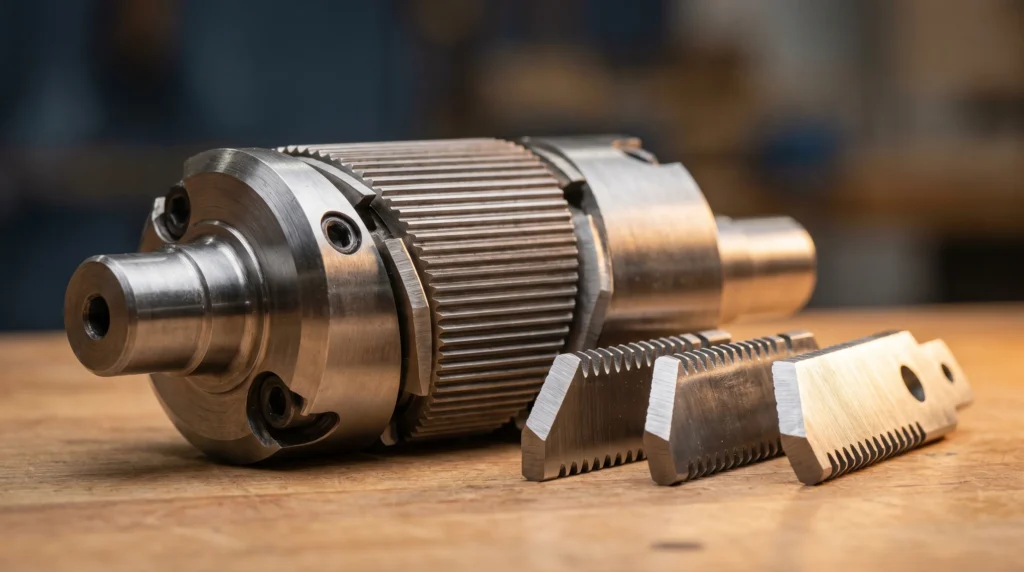
A corrugated back knife is a profiled blade with a series of ridges — the corrugations — machined into its back face. These ridges interlock with matching grooves in the cutterhead, creating a mechanical lock that prevents the knife from shifting under the forces of cutting. When the clamping bolts are tightened, the knife seats firmly and can’t creep forward, which is both a safety feature and a precision feature.
This locking system has been the industry standard in moulder tooling for decades because it works. The corrugations are typically spaced to a recognized standard pitch, which means knives and heads from compatible manufacturers can be intermixed — though it’s always worth confirming compatibility before assuming a mix-and-match approach will work on your machine.
The result of a well-matched knife and head is reliable, repeatable profiling. The knife stays where you set it, run after run. When it’s time to regrind, you remove the knife, send it out or grind it in-house, reinstall it to the same depth, and you’re back in production with the same profile geometry.
The Cutterhead: Your Foundation
The cutterhead is the body that holds the knives. It mounts on your machine’s spindle, and its design — diameter, width, number of knife slots, and corrugation pitch — determines what knives will fit it and how aggressively it will cut.
When choosing a cutterhead, start with your machine’s spindle bore and the maximum cutterhead diameter your machine can safely accommodate. Then consider the number of knife slots: a two-knife head and a four-knife head of the same diameter will produce different feed marks per linear foot at the same feed rate and RPM, because the four-knife head takes more cuts per revolution. More knife slots generally means a smoother surface, though it also means you’re buying (and maintaining) more knives.
Cutterhead width should be matched to the widest profile you intend to run. For dedicated profile runs, a head sized to the profile makes sense. For shops that run a variety of profiles, wider heads with segmented knife arrangements allow more flexibility.
Standard Profiles vs. Custom Grinds
One of the biggest practical questions when buying corrugated back knives is whether to use a standard profile from stock or to order a custom grind.
Standard profiles cover a broad range of moulding patterns — ogees, beads, coves, flutes, chamfers, roundovers, panel raises, and combination profiles. CGG Schmidt maintains a stock of more than 170 standard profiles, which means many common architectural and furniture profiles ship without the lead time of a custom order.
Custom grinds are the right choice when you need to match an existing architectural moulding exactly, replicate a legacy profile for a restoration project, or produce a proprietary shape that differentiates your product. The process is straightforward: provide a drawing, a wood sample, or a DXF file, and the knives are ground to match. Custom work does involve lead time and a setup cost, but for production runs where the profile must be exact, there’s no substitute.
Materials: What Should Your Knives Be Made Of?
As with other woodworking cutting tools, corrugated back knife material is a tradeoff between edge keenness, edge life, and cost of ownership.
S-Alloy steel is well suited to solid wood profiling where a very clean surface is the priority. It sharpens to a keen edge and regrinds readily, making it practical for shops with in-house grinding capability or regular send-out service.
Carbide-tipped knives are the choice for high-volume runs, for abrasive materials like MDF and particleboard, or for operations where the cost of frequent resharpening outweighs the higher purchase price. Carbide holds its edge significantly longer in abrasive conditions.
Solid steel knives remain a cost-effective option for solid wood work at moderate production volumes, offering good performance and easy serviceability.
Match the material to your stock and your run length, and you’ll get better total value regardless of which direction you go.
Why the Knife-Head Combination Matters
A knife is only as good as the head it runs in. Mismatched corrugation pitch means the knife won’t seat properly. A head that’s too narrow for the profile means the knife overhang becomes a problem. A head that’s worn or has damaged corrugation grooves won’t hold the knife securely.
When you’re specifying a complete setup, it’s worth treating the knife and head as a system rather than buying them independently from disconnected sources. CGG Schmidt supplies both knives and cutterheads and can help ensure your combination is properly matched.
It’s also worth thinking ahead about your profile lineup: if you run multiple profiles on the same machine, a system of heads and knives that are organized and labeled by profile saves real time at changeover.
Corrugated Back Knife and Cutterhead Buyer Checklist
Before purchasing, confirm:
- What is the spindle bore diameter and maximum safe cutterhead diameter on my machine?
- What corrugation pitch standard does my machine use?
- How many knife slots do I need (two-knife, four-knife, other)?
- What cutterhead width do I need for my widest profile?
- Is the profile I need available as a standard grind, or do I need a custom order?
- If custom: do I have a drawing, a sample piece, or a DXF file to provide?
- What material is my primary stock — solid wood, MDF, sheet goods, or a mix?
- What are my run lengths? Short custom runs or long production runs?
- Do I have an in-house regrinding setup, or will I send knives out for service?
- Am I buying knives to fit an existing head, or specifying a complete new setup?
Let’s Get Your Moulder Running Right
Corrugated back knives and cutterheads are a reliable, proven system — and with the right combination of head, knife, profile, and material, they’ll give you consistent results run after run. CGG Schmidt has been supplying moulder tooling to production shops and custom operations since 1926, and the breadth of our standard profile stock means there’s a good chance we have exactly what you need on the shelf.
Ready to find the right setup? Call us at 1-800-SCHMIDT or email sales@cggschmidt.com and let’s talk through your machine, your profiles, and your production needs.