English
 Français
 Español
 Português
 中国人
中国人
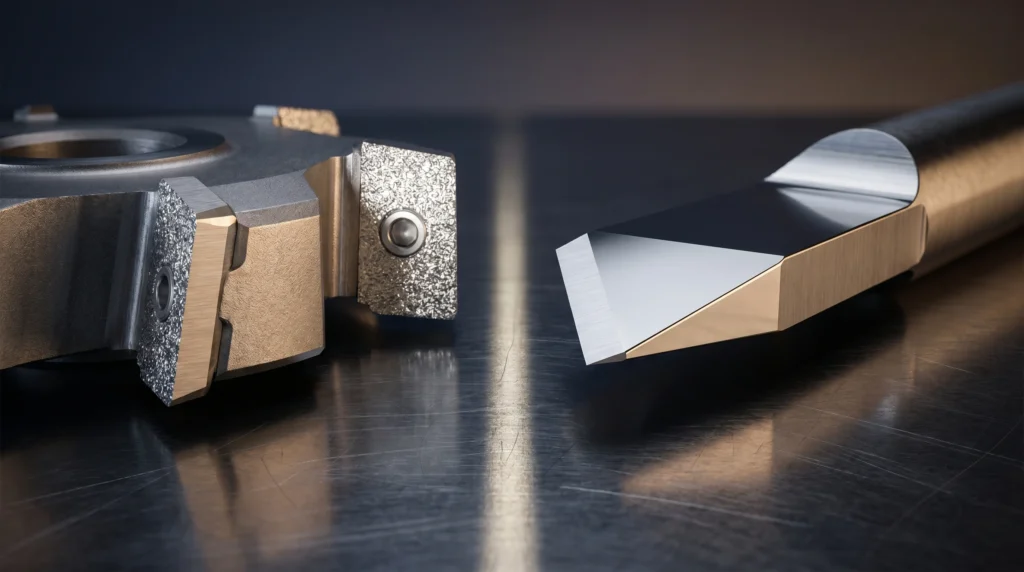
One of the most common questions woodworkers and shop managers ask when specifying new tooling is simple: carbide or high-speed steel? The honest answer is that neither is universally better — they’re built for different jobs, different materials, and different shop rhythms. Understanding the carbide vs. high-speed steel woodworking debate in practical terms will help you spend your tooling budget wisely and keep your machines running at their best.
What Is High-Speed Steel (and What Makes It High-Speed)?
High-speed steel (HSS) is a family of tool steels alloyed with elements like tungsten, molybdenum, and vanadium to resist softening at elevated temperatures — the “high speed” refers to cutting speeds that would ruin plain carbon steel. For woodworking, HSS and its premium variants (including the S-Alloy steel that CGG Schmidt pioneered for woodworking applications in the 1960s) are valued for their ability to take a very fine, keen edge and for the ease with which they can be reground.
In practice, a well-maintained HSS or S-Alloy knife can produce an exceptionally clean surface on solid hardwoods — sometimes clean enough to skip a sanding step. That’s not hyperbole; it’s the kind of result you get when the geometry is right and the edge is sharp.
What Is Carbide Tooling?
Carbide (specifically tungsten carbide) is a composite material — extremely hard tungsten carbide particles sintered together in a cobalt binder. In woodworking tooling, carbide typically appears as tips brazed onto a steel body. Solid carbide tools are also available for smaller-diameter applications like router bits and CNC tooling.
Carbide’s defining characteristic is hardness. On the Vickers scale, carbide sits far above any tool steel. That hardness translates directly to edge retention — a carbide edge simply stays sharp longer when cutting abrasive materials. The tradeoff is brittleness: carbide is more prone to chipping from impact or vibration than steel, and it requires diamond wheels to regrind, which means in-house resharpening is less accessible for small shops.
Edge Life: How Long Does Each Last?
This is where the material choice matters most in day-to-day production.
For solid wood — especially domestic hardwoods like oak, maple, and cherry — HSS and S-Alloy tools perform admirably and hold a working edge through meaningful production runs before needing attention. Edge life depends on species, moisture content, feed rate, and cut depth, but the key point is that solid wood is not inherently hard on steel.
The situation changes dramatically with engineered and composite materials. MDF, particleboard, plywood with adhesive layers, melamine, and laminate surfaces are far more abrasive than solid wood. The silica and resin content wears a steel edge noticeably faster. For these materials, carbide’s hardness translates to edge life that can be many times longer than steel — which in a production environment means fewer tool changes, less downtime, and more consistent cut quality over a shift.
Cost and Total Value
Carbide tooling typically costs more upfront than comparable HSS tools. That’s straightforward. But the right way to think about cost is total cost per linear foot of cut — factoring in how many regrinds you get, the cost of each regrind, and the time spent changing tools.
HSS and S-Alloy tools can generally be reground more times before they’re retired, and each regrind can be done on conventional grinding equipment (or sent to a service like CGG Schmidt’s profile knife grinding service). Carbide tips can also be reground, but require diamond tooling and appropriate equipment. When a carbide tip is worn beyond regrinding, the body can often be re-tipped.
For shops running solid wood at moderate volume, the regrindability and lower purchase price of HSS may deliver better total value. For shops running abrasive materials at high volume, carbide’s longer edge life reduces interruptions and often wins on total cost per part.
Regrindability and Maintenance
HSS/S-Alloy: Regrinds readily on standard CBN or aluminum oxide wheels. Many shops maintain these in-house. Each regrind removes a small amount of material, but a quality knife can see many service cycles before it’s undersized.
Carbide: Requires diamond grinding wheels. Regrinding carbide in-house is possible but requires investment in appropriate equipment. Most small shops send carbide out for service. Re-tipping is an option when tips are worn out.
CGG Schmidt offers a profile knife grinding service that covers both steel and carbide tooling, so you’re not left managing this on your own.
Comparison Table: Carbide vs. High-Speed Steel
| Factor | Carbide | HSS / S-Alloy |
|---|---|---|
| Upfront cost | Higher | Lower |
| Edge retention (solid wood) | Excellent | Very good |
| Edge retention (abrasive materials) | Excellent | Moderate |
| Regrindability | Requires diamond equipment | Standard grinding equipment |
| Surface finish on solid wood | Very good | Excellent (very keen edge) |
| Brittleness / chip risk | Higher (hard and brittle) | Lower (tougher) |
| Best for | Abrasive materials, long runs | Solid wood, profiles, varied work |
| Re-tip / recondition option | Yes | Regrind and re-profile |
Which Should You Choose? A Quick Guide by Shop Type
The Hobbyist or Small Custom Shop
If you’re running a small shop doing custom furniture, architectural millwork, or one-off projects primarily in solid hardwoods, HSS and S-Alloy tooling is likely your best match. The lower entry cost, the keen edge on solid wood, and the ability to resharpen on familiar equipment makes these tools practical and cost-effective at lower volumes. You’ll spend less upfront and still get excellent results.
The Mid-Size Production Shop
At mid-volume production — say, a cabinet shop running mixed stock including plywood and MDF alongside solid wood — a mixed approach often makes the most sense. Use carbide tooling on cutters that regularly contact sheet goods, and HSS or S-Alloy where you’re profiling solid wood and finish quality is the priority.
The High-Volume Production Facility
If your machines run all day on abrasive engineered materials, carbide is the clear answer. The reduced frequency of tool changes and the consistent edge life over long runs reduces downtime and keeps your output predictable. The higher upfront cost gets absorbed quickly when you’re running at scale.
The Bottom Line
There’s no single winner in the carbide vs. high-speed steel woodworking conversation — the right answer depends on what you’re cutting, how much of it you’re cutting, and what your resharpening infrastructure looks like. The good news is that you don’t have to figure it out alone.
The team at Charles G.G. Schmidt & Co. has been matching woodworking shops with the right tooling materials since 1926. If you’d like help thinking through your specific application, give us a call at 1-800-SCHMIDT or email sales@cggschmidt.com. We’ll give you a straight answer.