English
 Français
 Español
 Português
 中国人
中国人
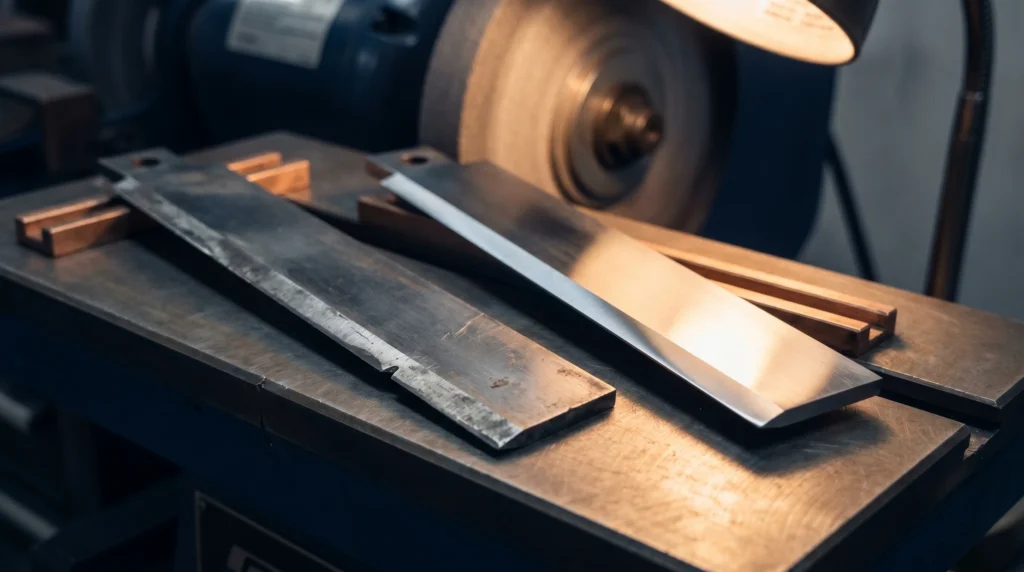
Knowing when to sharpen planer knives — and when to stop sharpening and simply replace them — is one of those judgment calls that separates shops running at peak efficiency from shops losing money one dull pass at a time. It sounds simple, but the line between “still worth grinding” and “time for new steel” can be surprisingly easy to miss if you don’t know what to look for.
Here’s a practical guide to reading your knives, understanding your options, and making the call that makes the most financial sense.
The Signs Your Planer or Jointer Knives Are Getting Dull
Dull knives don’t always announce themselves dramatically. More often they creep up on you, and by the time you notice the obvious signs, you’ve already been fighting them for a while. Watch for these:
Burning or scorch marks on the wood. Heat is the clearest signal. When a knife edge stops cutting cleanly, it starts dragging and creating friction. If you’re seeing discoloration along the surface of your workpieces — especially a faint brownish tinge on light-colored species — your knives are likely the culprit.
Raised grain and fuzzy surfaces. A sharp knife severs wood fibers cleanly. A dull one crushes and tears them. If your planed surfaces feel rough or fuzzy even at normal feed rates, the edge is no longer doing its job.
Tear-out, especially against the grain. Tear-out has multiple causes, but dull knives make it dramatically worse. If you’re seeing chunks lifted from the surface rather than clean fiber cuts, consider the condition of your tooling before adjusting anything else.
Increased feed resistance or motor strain. You might notice it as a subtle change in sound, or a machine that bogs down more than usual. Dull edges require more force to push material through, and that load transfers directly to your feed rollers and motor.
Poor surface finish that sanding won’t fully fix. If you’re spending more time at the sander to clean up surfaces that used to come off the machine ready to finish, your knives are telling you something.
Nicks and Chips: A Different Problem
Dullness is gradual wear. Nicks and chips are something else — sudden damage from a fastener, a stone in reclaimed lumber, or an impact during handling. A small nick will leave a raised line running the full length of every board you run through the machine. A single chip can make an otherwise serviceable set of knives practically unusable.
The good news: nicks and chips are often repairable through resharpening, as long as the damage isn’t too deep. A professional grind can remove enough material to get back behind the damage and restore a clean, straight edge. The question is always how much steel you have left to work with.
How Many Times Can a Knife Be Reground?
This is one of the most common questions we hear, and the honest answer is: it depends. The number of serviceable regrinds a planer or jointer knife can take is a function of how thick the knife is to begin with, how deep each grind needs to go to restore a clean edge, and what the minimum usable thickness is for your particular machine and knife style.
What we can say with confidence is that most quality planer and jointer knives have meaningful life left after their first few grinds, and that regular, timely resharpening — before knives get badly dulled or damaged — almost always extends the total number of usable grinds you’ll get. Letting knives run too long means grinding more material to get back to a clean edge, which shortens the knife’s overall lifespan faster than proper maintenance would.
The Cost Trade-Off: Grind or Replace?
The decision usually comes down to three factors:
- How much steel remains. If a knife is already close to minimum thickness, a full regrind might only buy you one more run before it’s scrap. In that case, replacement makes more financial sense.
- The cost of the knife itself. Standard planer and jointer knives in common sizes are relatively affordable to replace. Very long knives, wide-machine knives, or specialty profiles are a different story — here, getting every last regrind out of a knife is a real cost advantage.
- Whether the profile matters. For straight planer and jointer knives, replacement is straightforward. For profiled knives — molding knives with a specific shape ground into them — replacement often means re-grinding a new knife to match your profile anyway. Resharpening the existing knife, when steel allows, is almost always the faster and cheaper path.
When to Call in a Professional Grinder
Attempting to sharpen planer or jointer knives on-machine with a honing stone is fine for light touch-up work. But when you’re dealing with nicks, significant dullness, or knives that need to be matched as a balanced set, professional off-machine grinding is the right call. Precision grinding on proper equipment removes material uniformly, maintains the correct bevel angle, and ensures your knives come back balanced — which matters enormously for machine performance and longevity.
Ready to Get Your Knives Back in Shape?
At Charles G.G. Schmidt & Co., we’ve been grinding and resharpening woodworking tooling since 1926. Whether you need a standard planer knife reground, a profiled knife brought back to spec, or advice on whether your knives are worth saving, we’re here to help. Give us a call at 1-800-SCHMIDT, send an email to sales@cggschmidt.com, or ship us your knives — we’ll take an honest look and tell you exactly where you stand.