English
 Français
 Español
 Português
 中国人
中国人
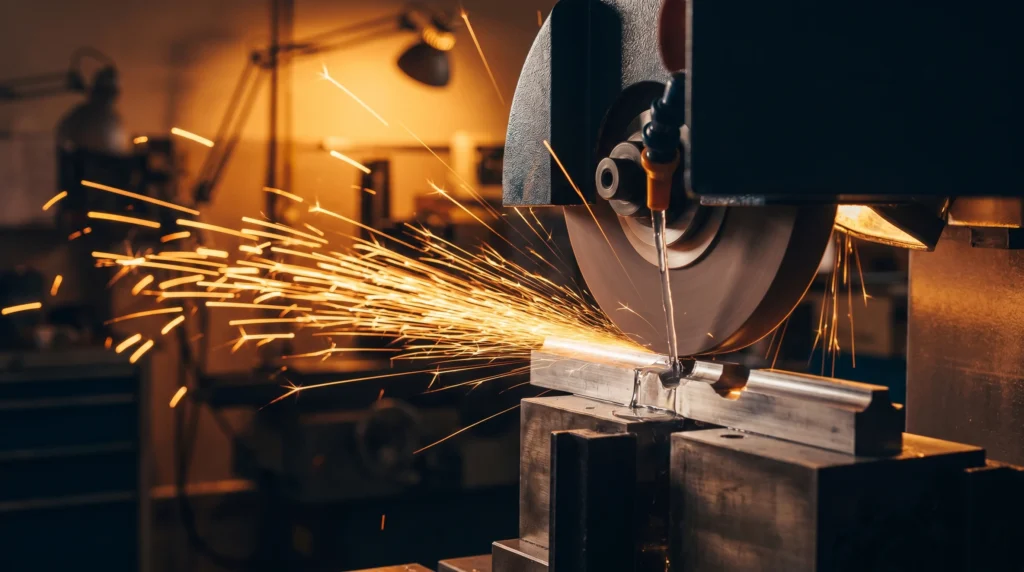
If you’ve ever needed a knife that matches a specific molding profile — an exact cove, a bead-and-fillet combination, a historic trim detail — you’ve encountered the world of profile knife grinding. It’s a specialized service that most woodworking shops eventually need, and one that’s easy to misunderstand. This post breaks down exactly what profile knife grinding is, how it works, and when it makes sense to use it.
What Is Profile Knife Grinding?
Profile knife grinding is the process of shaping a cutting tool so that its edge matches a specific cross-sectional profile — the shape it will cut into wood. Rather than a straight edge that removes material uniformly, a profiled knife cuts a specific contour: a raised panel shape, a door stop, a custom architectural molding, a tongue-and-groove configuration, or any other repeating profile your work requires.
The grinding process removes steel from a knife blank in a precise pattern, creating a mirror image of the desired cut. When that profiled edge runs across the wood, it leaves the matching positive shape behind.
This is fundamentally different from simply sharpening a straight knife edge. Profile knife grinding requires equipment capable of reproducing complex curves and angles accurately and repeatably — typically CNC grinding equipment guided by precise profile data, checked against optical comparators to verify the finished shape before the knife ever reaches a customer.
When Do Shops Need Profile Knife Grinding?
Profile knife grinding comes up in several common scenarios:
Reproducing an existing profile. You have a molding profile you’ve been running for years — but the knives are worn or damaged, and you need a new set that matches exactly. You can send us the original knives, a physical wood sample of the finished molding, a hand sketch with dimensions, or a DXF file. We work from whatever you have.
Matching historic or architectural profiles. Restoration work, historic renovation, and custom millwork often call for profiles that aren’t available off the shelf. Profile grinding lets you match original trim, reproduce discontinued patterns, or create something entirely new to your specification.
Custom product lines. Production shops running a signature profile — a distinctive edge treatment, a branded molding shape — rely on consistently ground knives to keep every run matching the last. Consistency is the whole point.
Replacing discontinued standard profiles. When a profile you’ve relied on is no longer available from your tooling supplier, custom grinding is often the most practical path to getting it back.
How CNC Grinding Reproduces a Profile
Modern CNC grinding is what makes profile knife grinding practical and precise. Here’s how the process generally works:
First, the profile data is established. If you’re sending a DXF file, that data is loaded directly into the grinding machine’s control system. If you’re sending a sketch or a physical sample, the profile is measured and digitized before grinding begins. Accuracy at this stage determines everything that follows.
Next, the grinding wheel is programmed to follow the profile path across the knife blank, removing material in a controlled sweep. CNC control means the grinding wheel moves in precise, repeatable increments — the same path, held to tight tolerances, every time.
Finally, the finished knife is checked against the profile specification using an optical comparator — a device that projects a magnified silhouette of the knife edge onto a screen, where it can be compared directly against the target profile. Any deviation shows up immediately and can be corrected before the knife ships.
The result is a knife that matches your profile specification consistently, whether you’re ordering one knife or a full production set.
Standard Profiles vs. Custom Grinding
Not every profiled knife needs to be ground from scratch. At CGG Schmidt, we maintain a library of 170-plus standard profiles in stock for corrugated heads and the Williams & Hussey molder — common shapes like beads, coves, ogees, rabbets, and chamfers that cover a wide range of everyday woodworking applications. If your profile matches one of those standards, you can often get what you need faster and at lower cost than a fully custom grind.
When your profile doesn’t match a standard, that’s when custom grinding earns its place. And because we’ve been doing this since 1926, we’ve seen an enormous variety of profiles — which means we can often recognize when a “custom” request is actually close to a standard we have on file, and help you decide which approach makes the most sense.
What You Need to Send Us
One of the most common questions we get is: “What do I need to provide?” The answer is: whatever you have. We can work from:
- A sketch with dimensions (even a rough hand drawing is a starting point)
- A wood sample showing the finished cut
- Original worn knives we can measure and match
- A DXF file from your CAD system
The more precise your input, the faster we can move. But if all you have is a piece of molding and a rough idea of what you need, that’s a conversation worth having.
Let’s Reproduce Your Profile
Charles G.G. Schmidt & Co. has been specializing in profile knife grinding since 1926. Whether you need a knife matched to a historic profile, a custom shape for a new product line, or a standard profile from our library, we’re ready to help. Call us at 1-800-SCHMIDT, email sales@cggschmidt.com, or send us your profile — sketch, sample, DXF, or original knife. We’ll take it from there.