English
 Français
 Español
 Português
 中国人
中国人
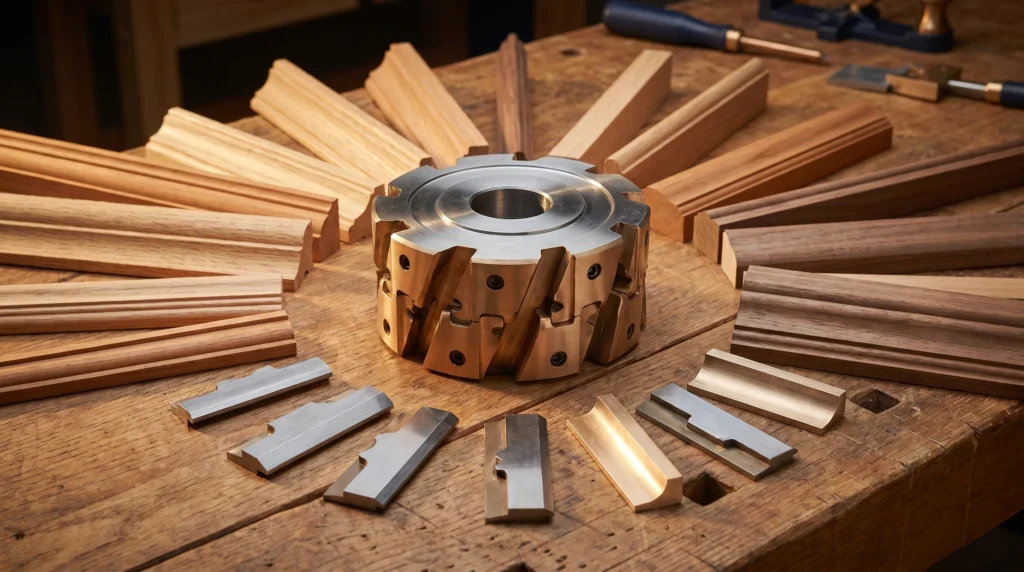
The moulder is a production workhorse found in millwork shops, flooring plants, door and window manufacturers, and custom woodworking operations of all sizes. When it’s set up right and equipped with the right tooling, a moulder produces clean, consistent profiles at impressive throughput. When the tooling isn’t matched to the job, you get tearout, chatter, short knife life, and a lot of frustration. This moulder tooling guide covers the main tool types, how to choose among them, and practical tips for getting the most from your setup.
What Makes Moulder Tooling Different?
Moulders are multi-spindle machines — typically four to six heads — that shape all four faces of a workpiece in a single pass. Each spindle needs its own tooling, and the profiles on each head must be designed to work together. That coordination is a big part of what separates moulder work from single-machine setups. The tooling also runs under much higher feed rates and production volumes than most other machines, so durability and balance matter enormously.
Corrugated Back Heads: The Production Standard
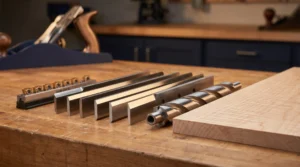
The corrugated back system is the most widely used approach in production mouldering. A profiled steel knife — ground to your exact shape — locks into a matching corrugated head via the ridged pattern on the back of the knife. The corrugations prevent the knife from shifting under load, and the system allows knives to be removed, resharpened, and reinstalled accurately.
Corrugated heads are available in a range of widths and bore sizes to fit virtually any moulder spindle. The knives themselves can be:
- Standard profiles — common shapes stocked or quick-produced, like ogees, coves, roundovers, and beads
- Custom profiles — ground to a sketch, a sample piece of moulding, or a DXF file you supply
For shops that run many different profiles — custom millwork, architectural work, flooring patterns — the corrugated system’s flexibility is hard to beat. A set of heads stays on the machine; only the knives change.
Profile Knife Materials: Steel vs. Carbide
Most moulder knives are ground from high-speed tool steel. For many applications — clear softwood, hardwood, and standard solid lumber — steel knives provide excellent surface quality and are relatively easy to regrind.
Carbide-tipped or solid-carbide options make sense when:
- Running abrasive materials like MDF, particleboard, or engineered composites
- Processing lumber with embedded grit, sand, or reclaimed wood with unpredictable inclusions
- Running long production campaigns where downtime for knife changes is costly
Carbide holds an edge far longer in these conditions. The tradeoff is that carbide is more brittle and is harder to regrind in-house without specialized equipment. Many shops run steel knives on clear lumber lines and keep carbide heads available for sheet-good or composite runs.
Insert Tooling for Moulders: Fast Changeovers, Consistent Results
Insert-style moulder heads use indexed carbide inserts rather than ground-profile knives. Worn or chipped inserts are swapped out in minutes without sending anything out for grinding. For shops that value uptime and run profiles long enough to justify the tooling investment, insert systems are increasingly popular.
Benefits in a production moulder context:
- No grinding downtime — change inserts at the machine
- Indexing geometry ensures consistent profile placement every time
- Insert bodies can often accept multiple profile styles
The limitation is that insert tooling is best suited to standard profiles. For highly custom architectural shapes, corrugated knives ground to your spec are still the more practical choice.
The Williams & Hussey System
The Williams & Hussey moulder is a compact, single-head machine designed for smaller shops that need moulding capability without the footprint or cost of a full production moulder. It uses a simpler knife system — typically flat, profile-ground knives held in a head — and runs at relatively high speed.
CGG Schmidt supplies knives specifically for the Williams & Hussey system. If your shop runs one of these machines, you can order:
- Standard profile knives from the Williams & Hussey profile catalog
- Custom-ground knives to profiles you specify
The Williams & Hussey is a capable machine for lower-volume custom work, small-shop millwork, and one-off architectural profiles. Having a reliable knife supplier who understands the system saves you a lot of searching.
Selecting Profiles: Starting From a Sample or a Drawing
One of the most common challenges in moulder work is replicating an existing profile — whether you’re matching a historical moulding, continuing a production run from an old knife set, or producing custom millwork to an architect’s specification.
The most reliable approach is to supply a physical sample of the finished profile. A good tooling manufacturer can work from that sample to grind knives that produce a match. DXF files work well too, especially when the profile is being generated from a design file. Sketches with dimensions are a third option — just be as precise as possible on radii, depths, and transition points.
Production Tips for Moulder Tooling
Getting good results from your moulder tooling isn’t just about the knives. A few habits make a real difference:
- Balance your heads. Unbalanced heads cause chatter and vibration that shows up in the finished surface and accelerates bearing wear.
- Match feed rate to knife count and chip load. Overfeeding leads to tearout; underfeeding can cause burning and dulls knives faster.
- Rotate knives in the set. When grinding a set of corrugated knives, all knives in the head should be ground together so they’re matched in height and profile.
- Inspect knife seats regularly. Debris in the corrugated seat affects knife seating and can cause profile creep.
- Track your linear footage. Good records help you regrind or replace before quality drops rather than after.
Ready to Talk Profiles?
CGG Schmidt has been producing moulder knives and heads — both standard and fully custom — for decades. Whether you need a complete head-and-knife setup for a new profile, replacement knives for your Williams & Hussey, or carbide tooling for a composite run, we can help.
Reach us at 1-800-SCHMIDT or [email protected]. Send a sample, a DXF, or just a description — and we’ll get your moulder running the profile you need.