English
 Français
 Español
 Português
 中国人
中国人
There’s a phrase you hear in manufacturing that’s easy to gloss over: “tight tolerances.” It sounds like a marketing term. But in cutting tool manufacturing, tolerance is the difference between a tool that runs true and one that vibrates, between a profile that comes off the machine ready to use and one that needs hand fitting, between a set of knives that match on reassembly and a set that requires a reset every time. Precision in CNC tool manufacturing is not a marketing claim — it is a measurable, practical advantage that shows up in every cut.
Why Precision Starts at Manufacturing
A cutting tool performs exactly as well as it was made to perform. That seems obvious, but it has real implications. If a tool is ground even slightly out of balance — if one knife in a set is a thousandth of an inch taller than the others — that knife takes a disproportionate share of the cutting load. It wears faster. It generates more vibration. And that vibration translates directly to surface quality: the subtle chatter marks, the slightly fuzzy finish, the profile that looks right in the shop and shows imperfections when it’s painted or finished.
This is why the manufacturing process matters as much as the material. A perfectly specified geometry in a premium alloy, ground to loose tolerances, will underperform a good geometry ground to tight ones.
CNC Grinding: Consistency at Scale
The introduction of CNC grinding equipment transformed cutting tool manufacturing. Where conventional grinding relied on the skill and consistency of a single operator — with all the natural variation that implies — CNC grinding is programmed, repeatable, and verifiable.
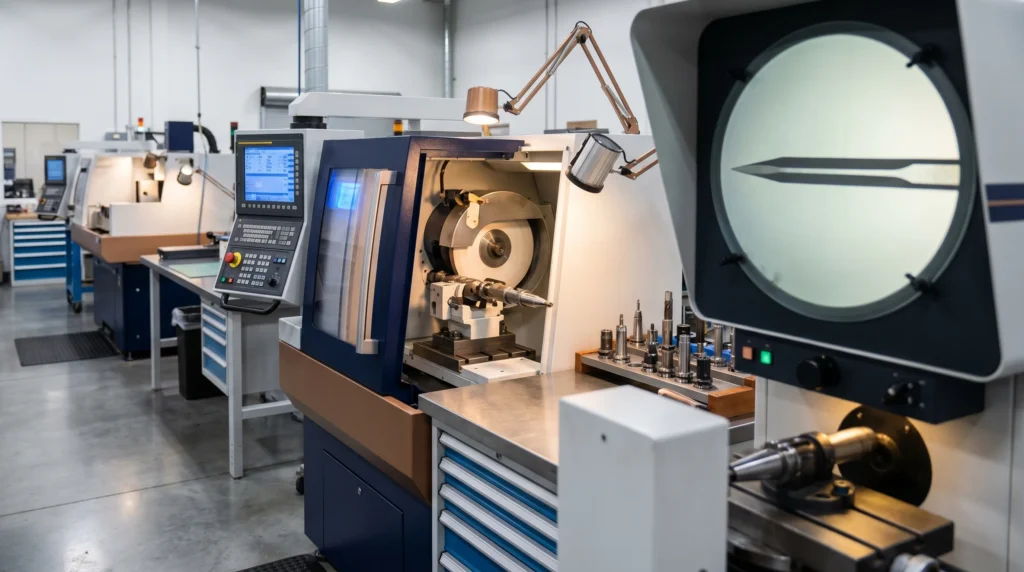
At Charles G.G. Schmidt & Co., our CNC grinding equipment allows us to hold tolerances across complex profiles that would have been impractical to achieve consistently on manual machines. A moulder knife with a detailed architectural profile involves dozens of individual points along its cutting edge; each of those points must be ground to the correct height, angle, and radius. CNC grinding executes that profile the same way every time, whether we’re producing a single replacement knife or a matched set.
Repeatability across a set is especially important. Matched knife sets — for planer heads, moulder heads, and similar multi-knife configurations — must be consistent with each other, not just individually accurate. A CNC-ground set can be matched to tolerances that ensure the load is shared evenly and the finished profile is identical from knife to knife.
EDM: Precision Where Grinding Can’t Reach
Electrical Discharge Machining — EDM — uses controlled electrical sparks to erode material with extraordinary precision. It is not a process most end users think about, but it enables tool forms and features that conventional grinding cannot produce reliably.
In cutting tool manufacturing, EDM is particularly valuable for producing carbide-tipped tools with complex geometries, for creating precise relief angles in tight spaces, and for any application where the tool form must be held to very fine tolerances in areas that a grinding wheel cannot access cleanly. The process is slow by production standards, but for the specific features it addresses, it is simply more accurate than the alternatives.
The practical result: tools made with EDM as part of the process can hold geometry in areas that matter for fit and function — carbide pocket geometry, for instance, directly affects how well a tip is brazed and supported, which in turn affects how the tool performs and how long it lasts.
Optical Comparators: Measuring What Matters
Manufacturing a tool accurately is only half the equation. You also need to measure it accurately enough to know whether it was made correctly. This is where high-powered optical comparators come in.
An optical comparator projects a magnified silhouette of the tool — or a section of it — onto a screen or digital display, where it can be compared against a template or measured directly. At high magnification, even small deviations from the intended geometry become visible and measurable. This is not just a quality control check at the end of the process; it informs grinding decisions throughout production.
For profile tools especially — moulder knives, shaper cutters, custom router bits — the comparator allows our team to verify that every critical radius, every transition between profile elements, every angle is within specification before the tool ships. A profile that looks correct to the naked eye may reveal deviations under the comparator that would show up as imperfection in the finished workpiece.
What Precision Means for Your Shop
The connection between manufacturing precision and shop-floor performance is direct:
Better surface finishes. Tools ground to tight tolerances run with less vibration and produce cleaner cuts. Surfaces that come off the machine smoother require less downstream sanding and finishing work — a real savings in time and labor.
Longer tool life. A balanced, well-matched tool set distributes cutting load evenly. Knives that are sharing the work correctly wear more uniformly and last longer before they need to be rotated or resharpened.
More consistent profiles. For shops running architectural millwork, furniture components, or any profiled product, profile consistency from piece to piece is a quality standard. Tools ground to tight tolerances deliver that consistency; tools ground loosely do not.
Faster setup. Replacement knives or tool sets that were made to the same tight tolerances as the originals drop in and run without extensive adjustment. That saved setup time adds up quickly in a production environment.
Craftsmanship and Technology Together
At CGG Schmidt, we think of precision manufacturing not as a technical specification but as a commitment to the people using our tools. Every shop that installs a set of our knives is trusting that the tool will do what it was specified to do — cut cleanly, run true, and hold up over time. That trust is earned through the combination of skilled people and capable equipment: CNC grinding, EDM, optical comparators, and the accumulated experience of a company that has been making cutting tools since 1926.
If you’d like to discuss your tooling requirements — whether it’s a standard product line item or a fully custom profile ground to your specifications — we’re ready to help. Reach us at 1-800-SCHMIDT or [email protected].