English
 Français
 Español
 Português
 中国人
中国人
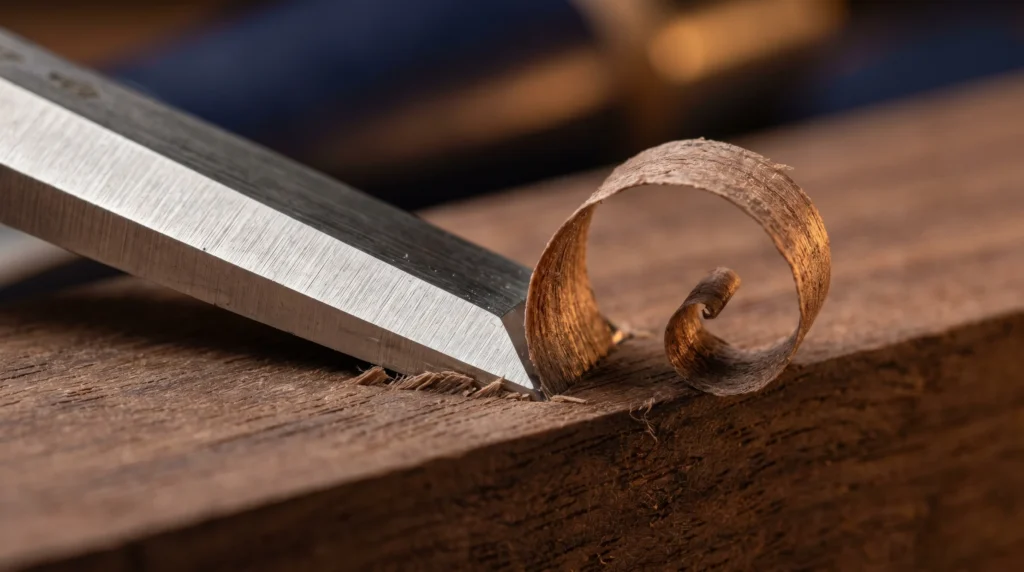
If you’ve ever had a finishing cut leave a slightly torn or fuzzy surface, or noticed that a tool seems to “grab” at the wood rather than slice through it cleanly, there’s a good chance the answer lives in tool geometry. The angles ground into a cutting tool aren’t arbitrary — each one is an engineering decision that directly affects how the tool enters the material, how cleanly it severs fibers, and how it exits without pulling the surface apart. Understanding cutting tool hook angle and its companions is the foundation for specifying tooling that actually fits the job.
The Three Core Angles
Every woodworking cutting tool has at least three angles that matter: the hook (or rake) angle, the clearance angle, and — in many profiled tools — a shear angle. They work together, and changing one often has implications for the others.
Hook Angle (Rake Angle)
The hook angle is the angle between the face of the cutting edge and a line drawn radially from the tool’s center. A positive hook angle means the face of the tool is angled forward — the cutting edge leans toward the material. A negative hook angle means the face leans away.
Positive hook angles are aggressive. The tool presents a forward-leaning face to the wood, which tends to pull the material into the cut. This produces fast, clean shearing in many solid wood applications, particularly with straight-grained softer species. The wood fiber is sliced rather than compressed and torn.
Negative hook angles are more conservative. The cutting edge is backed off, so it scrapes and compresses the fiber before severing it. This takes more power, generates more heat, and typically leaves a slightly rougher surface in solid wood — but it is far more stable and controllable in abrasive or layered materials like MDF and composite panels, where an aggressive hook angle can cause chipping at exit edges.
A hook angle of 0° sits between these poles: the cutting face is perfectly radial, neither leaning in nor away. This is a neutral starting point and often a good choice for general-purpose work.
Clearance Angle (Relief Angle)
The clearance angle is ground on the back face of the cutting edge — the side that trails behind as the tool rotates. Its purpose is simple but essential: it prevents the body of the tool from rubbing against the freshly cut surface.
Without adequate clearance, friction heat builds up immediately behind the cutting edge. That heat burns the wood surface, accelerates edge wear, and increases power demand. Too much clearance, though, and you’ve thinned the wedge of material supporting the cutting edge, reducing its strength and making it more vulnerable to chipping.
For most woodworking applications, clearance angles typically fall in the range of 10° to 20°, depending on the material and the aggressiveness of the hook angle. Softer, more fibrous materials often benefit from slightly more clearance. Dense, hard materials — or abrasive composites — favor a more conservative clearance that leaves more metal supporting the edge.
Shear Angle
The shear angle is a bit different: rather than affecting the cross-section of the cutting edge, it describes how the edge is oriented lengthwise relative to the direction of cut. A tool with a positive shear angle doesn’t engage the full width of its edge simultaneously — it enters the material progressively, from one side to the other.
This progressive engagement dramatically reduces the shock load on the tool at entry and at exit, and it tends to produce a much smoother surface finish, particularly at the edges of boards where tear-out is most likely. The trade-off is slightly increased lateral force, which must be managed in the machine setup. Shear angle is especially valuable in wide planer and moulder applications, and in any situation where end grain or difficult grain is part of the workpiece.
How These Angles Interact in Practice
No angle works in isolation. A tool with a highly positive hook angle and low clearance is quite different from one with a positive hook and generous clearance. The key is matching the combination to the demands of the application.
General guidance — angle choices by material and effect:
| Material / Condition | Hook Angle | Clearance Angle | Shear Angle |
|---|---|---|---|
| Softwood, straight grain | +15° to +20° | 12° to 15° | Moderate benefit |
| Domestic hardwood, mixed grain | +10° to +15° | 12° to 15° | High benefit |
| Figured or reversing grain | +5° to +10° | 12° to 15° | Strongly recommended |
| MDF / particleboard | -5° to +5° | 15° to 20° | Low to moderate |
| Melamine / laminate | -5° to 0° | 15° to 18° | Moderate benefit |
| Softwood composites / LVL | 0° to +5° | 15° to 20° | Moderate benefit |
This table represents general guidance only. Optimal angles depend on machine speed, feed rate, tool diameter, and specific material characteristics.
The Practical Takeaway: Tear-Out and Feed Rate
Two of the most common complaints in production shops are tear-out on figured or reversing grain, and inconsistent surface quality across species. Both often trace back to geometry that hasn’t been matched to the work.
Tear-out at the trailing edge of a cut — especially on hardwood faces or at the end of a profile — is almost always a geometry and feed rate problem. Increasing the shear angle, moderating the hook angle, and ensuring adequate clearance will address tear-out more reliably than simply slowing the feed or changing to a different material entirely.
Feed rate interacts closely with hook angle. An overly positive hook angle at a slow feed rate can actually cause the tool to “climb” into the material rather than cut smoothly, generating a rough surface. At higher feed rates, that same hook angle may perform beautifully. Understanding the relationship between geometry and feed rate helps shops dial in their processes rather than compensating for geometry problems with machine settings.
Getting the Geometry Right
Specifying tool geometry correctly requires knowing the material, the machine, the expected feed rate, and what surface quality the downstream process needs. That’s a lot of variables — but it’s exactly the kind of problem that a manufacturer who makes tools to order is set up to help you solve.
At Charles G.G. Schmidt & Co., custom geometry is part of what we do every day. If you’re seeing tear-out, burning, excessive edge wear, or inconsistent finishes, a conversation about your current tool geometry is often the fastest path to a solution. Call us at 1-800-SCHMIDT or email [email protected] and let’s work through the angles together.