English
 Français
 Español
 Português
 中国人
中国人
Good woodworking tooling isn’t cheap, and the gap between a tool that lasts years and one that dulls in weeks often has less to do with the tool itself than with how it’s being used and cared for. If you want to extend tool life in woodworking — whether that’s planer knives, profiled molding knives, router bits, or saw blades — the fundamentals aren’t complicated. They just require consistency.
Here’s a practical rundown of the habits and practices that make a real difference.
Match Your Feed Rate and Speed to the Material
Running tooling too fast or too slow for the material you’re cutting is one of the fastest ways to shorten tool life. The goal is a chip load — the amount of material removed per cutting edge per revolution — that’s appropriate for the species, density, and condition of the wood.
Too high a feed rate and you’re asking each cutting edge to bite off more than it can handle cleanly. You’ll see tear-out, rough surfaces, and excessive wear. Too low a feed rate and you risk rubbing rather than cutting, which generates heat and dulls edges quickly.
For most planer and molder work, the machine manufacturer’s guidelines are a reasonable starting point. Beyond that, paying attention to surface quality and machine sound will tell you a lot. A machine working smoothly at the right chip load sounds different from one that’s straining or chattering — and the wood surface tells the same story.
Running harder species like hard maple or hickory requires more conservative feed rates and sharper tooling than softer species like pine or poplar. Abrasive materials like MDF or particleboard are harder on cutting edges than solid wood, because the resins and particles in the material act as a mild abrasive. Plan accordingly.
Keep Tooling Clean
Pitch, resin, and wood residue build up on cutting edges over time, and that buildup affects performance in two ways. First, it changes the effective geometry of the cutting edge — adding material in places that changes how the tool interacts with the wood. Second, it holds moisture against the steel, accelerating corrosion.
Clean your tooling regularly with an appropriate resin remover or solvent. For router bits and shaper cutters, periodic cleaning is quick and makes a noticeable difference in cutting performance and finish quality. For planer and jointer knives, clean the knife slots and gibs as well as the knife edges themselves — grime in the head assembly affects knife seating and can cause vibration.
Prevent Rust and Corrosion
Rust is a slow knife killer. Even surface rust can pit a cutting edge enough to degrade performance, and deeper corrosion can make a knife unsalvageable.
The basics: don’t leave tooling sitting in a damp environment, and apply a light coat of rust-inhibiting oil to bare steel surfaces whenever tools are going into storage. Wax-based products work well for table surfaces and exposed metal; light machine oil works for stored tooling. If your shop runs humid in summer, a dehumidifier is an investment that pays for itself in reduced corrosion-related tool replacement.
For knives removed from machines, wipe them down before storage. A few seconds of care after each use adds up to significantly longer tool life over the course of a year.
Store Tooling Properly
How you store cutting tools matters more than most people realize. Knives and bits stored loose in a drawer bang against each other, dulling edges and chipping carbide. Saw blades stacked flat without protection scratch and ding their teeth.
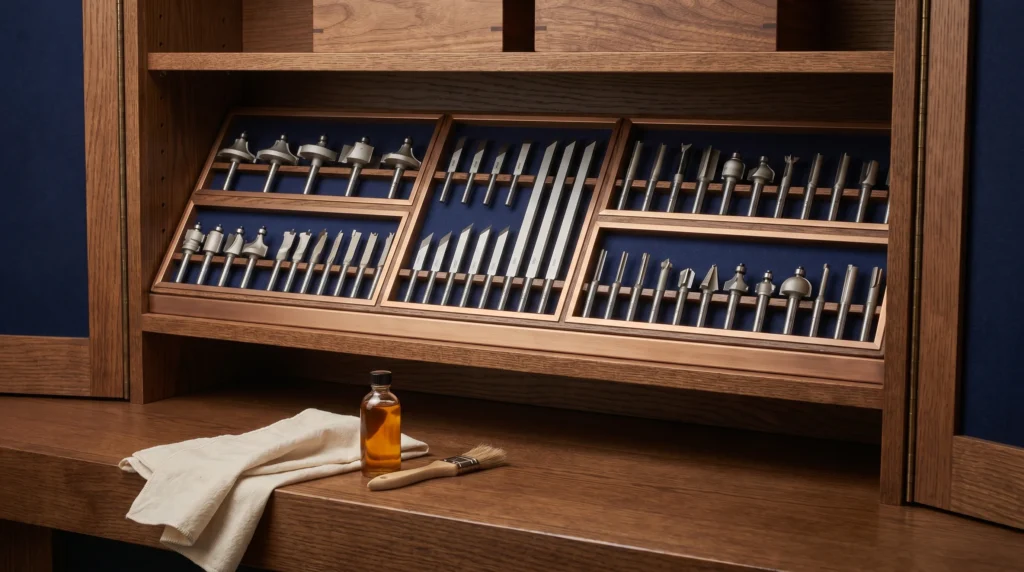
Invest in proper storage: individual slots or separators for planer and jointer knives, dedicated cases or pouches for router bits and shaper cutters, vertical storage for saw blades. Hanging knife racks work well for profiled knives you pull in and out regularly. The goal is that no cutting edge touches another cutting edge or a hard surface during storage.
Labeling stored tooling — especially profiled knives — also saves time and prevents the wrong knife from going into a machine.
Sharpen on Schedule, Not in Crisis
The single most effective thing you can do to extend tool life is sharpen tooling before it gets badly dull, not after. This sounds counterintuitive — more frequent sharpening means more grinds, right? — but the math works out in your favor.
A knife that goes in for resharpening when it’s slightly dull requires a light grind to restore the edge. A knife that’s run until it’s leaving burn marks and fuzzy grain requires significantly more material removal to get back to clean steel. Each heavy grind takes more off the knife than two or three light grinds would have. Over the total life of the tool, timely sharpening means more usable grinds before the knife reaches minimum thickness.
There’s also the cost of what dull tooling does to your work in the meantime — more sanding, more rejects, more time. The economics of timely sharpening almost always favor the shop that stays ahead of the curve.
Match the Tool to the Job
Using the right tool for the material and cut is basic advice, but it’s worth saying plainly because it’s routinely ignored. Carbide-tipped tooling handles abrasive materials — MDF, plywood, composites — far better than high-speed steel. Solid carbide router bits hold up in production routing applications where HSS bits would dull in hours. Profiled knives ground in the right material for your specific application last longer and produce better results than a close-enough substitute.
When you’re unsure whether a tool is the right match for a job, it’s worth a phone call to your tooling supplier before you run a production job and discover the hard way.
Put It All Together
None of these practices is difficult in isolation. The shops that get the most from their tooling are simply the ones that apply all of them consistently — clean tools, correct feeds, proper storage, timely sharpening, right tool for the job. Each habit reinforces the others.
When it does come time to sharpen or regrind, Charles G.G. Schmidt & Co. is here to help you get the most out of every knife. We’ve been grinding woodworking tooling since 1926 — call us at 1-800-SCHMIDT or email [email protected] to discuss your resharpening needs, or send us your knives and let us take a look.